Gathered in Gold
Gathered in Gold: The Hay Bales of Dufferin and Clearview Ontario
There is a particular kind of beauty that only late August in this part of Ontario can give you. Drive the back roads between Grand Valley and Creemore right now — the Sixth Line, Airport Road, any of the gravel stretches that wind past the escarpment — and you’ll find fields dotted with big round bales, sitting gold against green, catching the evening light like something out of a painting. I have shown a lot of country properties over the years, and I still slow the car down every single time.
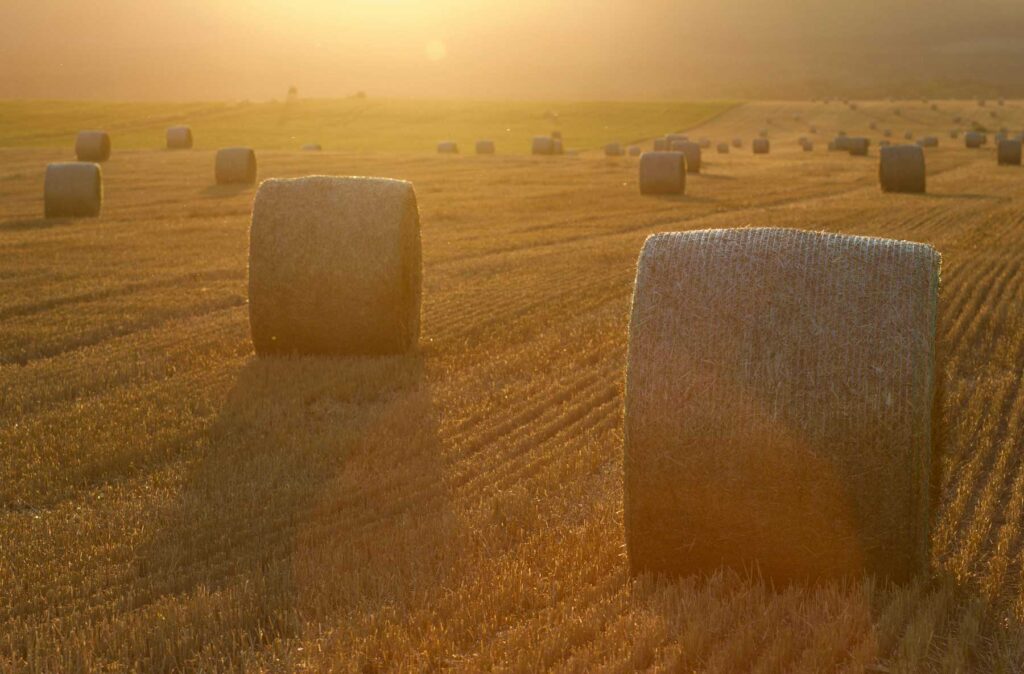
These fields have quietly become a favourite backdrop for golden-hour photography
It’s easy to assume they’re just there for the view. They’re not — though I understand the mix-up, because they really are that pretty. What you’re looking at is the last, quiet step of a much busier process. Hay is cut, then left to dry in the sun until just enough moisture has left it to store safely through winter — too wet and it can mold, or worse, heat up in storage; too dry and it loses the very nutrition a herd needs when the snow flies. Once it’s cured, the baler rolls through and gathers it into those handsome cylinders, and the farmer lets them sit a while before collecting — the curve of a well-formed bale sheds rain almost like a little thatched roof. The ones wrapped tight in white or green plastic are usually baleage, put up slightly wetter and sealed to preserve its goodness. It is, in its own way, a beautifully practical piece of design.
It hasn’t always looked like this. For most of the last century, hay in Dufferin and Simcoe was put up loose, then in small square bales a person had to hoist by hand — real, all-hands-on-deck work that many longtime neighbours still remember well. The big round baler changed that in the 1960s and ’70s, letting one person on a tractor do in an afternoon what once took a family a week. And the land underneath it all has an even older story: these rolling drumlin hills were shaped by glaciers long before the first settler farms went in, and they’ve been growing hay and pasture ever since — a rhythm that still marks the calendar here every bit as much as the county fair does.
What’s newer, and rather delightful, is what happens once someone reaches for their phone. These fields have quietly become a favourite backdrop for golden-hour photography — engagement sessions, family portraits, the occasional very patient dog — with visitors politely knocking on the farmhouse door first to ask. Local fairs have leaned right into it, too: hay bale decorating contests, where a bale becomes a pumpkin or a favourite character for the weekend, have turned into their own small burst of September charm on TikTok and Instagram. A few farms nearby have even added simple photo stops of their own, a lovely little way of inviting the rest of us in to see where the season’s work actually happens.
I think that’s really the heart of it. A hay bale is a working thing before it’s a pretty thing — but out here, it manages to be both, beautifully. It’s one more small reason I love this part of the world so much, and one more reason I love getting to show it to people looking for a place of their own among these fields.
Would you like to explore the area we cover around the Headwaters and beyond? Reach out and talk to one of our buyer agents, or explore our current listings.
Share
More Posts
Tips, advice, news and more. Scroll through our blogs for interesting reads.
